The AI Job Revolution: What the Data Actually Says
Before we panic (or celebrate), let’s look at what the research actually tells us about AI and employment.
Key Statistics You Need to Know
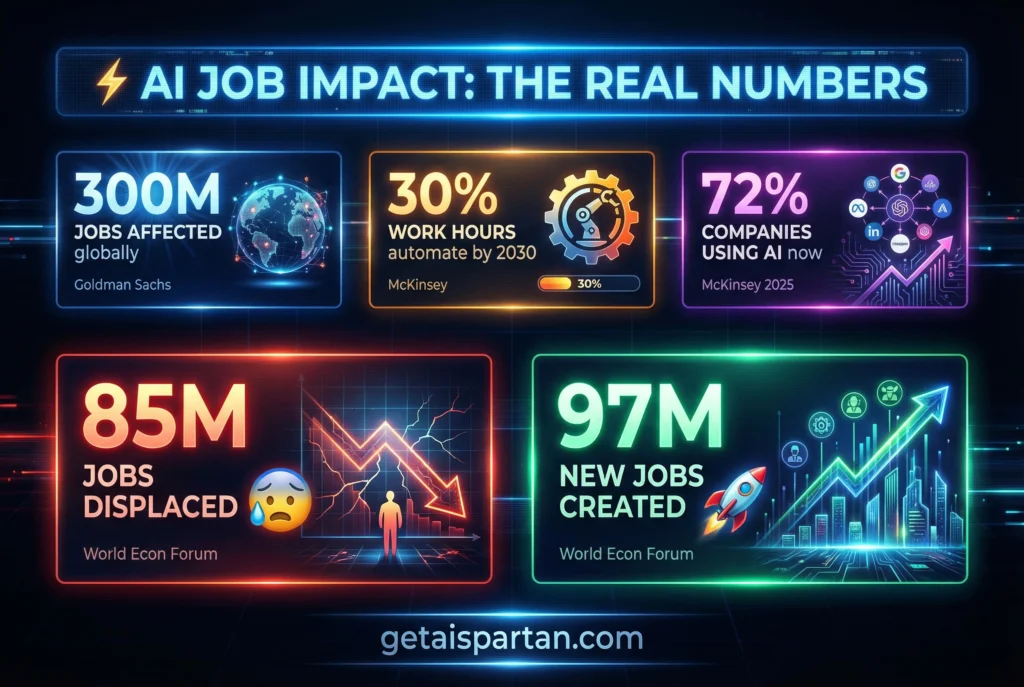
The numbers paint a picture that’s neither purely apocalyptic nor purely optimistic:
Here’s what most people miss: “Affected” doesn’t mean “eliminated.”
When Goldman Sachs says 300 million jobs are “affected,” they mean those jobs will change — not that 300 million people will get fired tomorrow.
Why 2025-2027 Is the Tipping Point
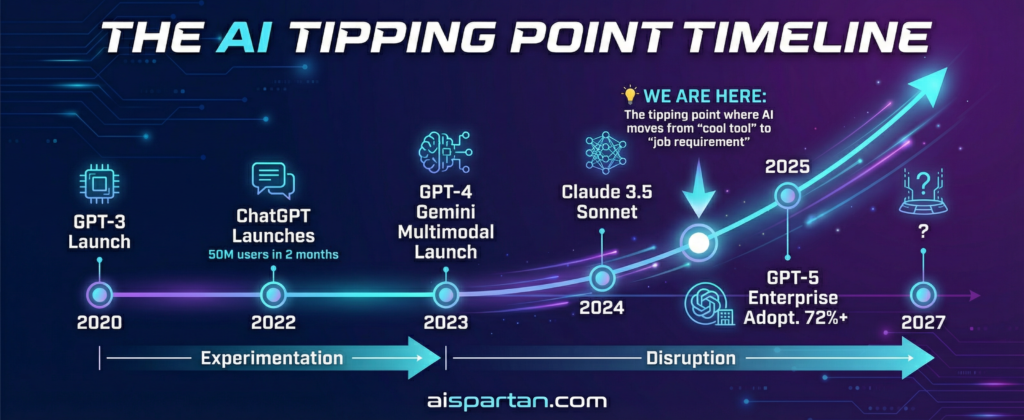
We’re living through the most critical window in AI’s impact on employment, and here’s why:
The technology has crossed a threshold. GPT-4o, Claude 3.5, Gemini 2.0, and their successors aren’t just answering trivia questions anymore. They’re writing legal briefs, generating marketing campaigns, analyzing financial data, coding entire applications, and creating photorealistic images — all at a fraction of the cost of human labor.
Enterprise adoption is accelerating. According to McKinsey’s 2025 survey, 72% of companies have now adopted AI in at least one business function, up from 55% just one year earlier. These aren’t experiments anymore. They’re permanent operational changes.
The cost equation has tipped. When an AI tool can do in 30 seconds what used to take an employee 3 hours — and costs $20/month instead of $5,000/month in salary — the economic pressure becomes irresistible.
"Replace" vs. "Transform" — The Critical Distinction
This is the single most important concept in this entire article, so pay close attention:
“AI rarely eliminates entire jobs. It eliminates tasks within jobs.”
Think about ATMs. When they appeared in the 1970s, everyone predicted bank tellers would vanish. Instead, the number of bank tellers actually increased because ATMs made it cheaper to open new branches. But the role of bank tellers changed — from cash-handling to relationship-building and sales.
The same pattern is happening with AI right now.
The 80/20 rule of AI displacement works like this:
- ~20% of jobs will be significantly displaced (major restructuring or elimination)
- ~60% of jobs will be transformed (some tasks automated, new tasks added)
- ~20% of jobs will be largely unaffected or enhanced
Your mission is to figure out which category YOUR job falls into — and then act accordingly.
Jobs AI WILL Replace (High Risk List)
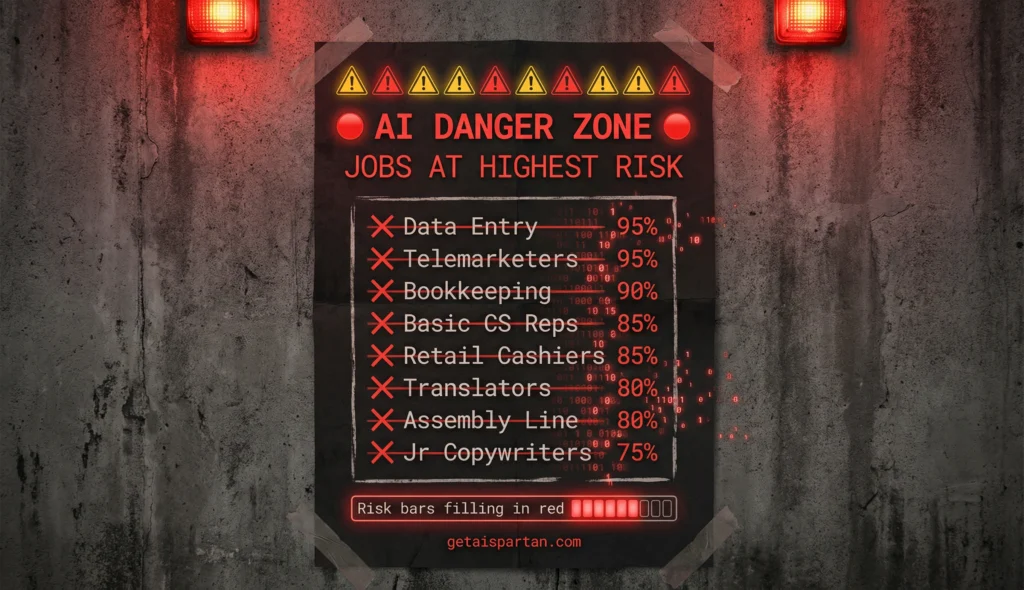
Let’s be direct. These are the roles facing the highest risk of significant AI displacement between now and 2028. If your job is on this list, don’t panic — but do start planning.
Data Entry & Processing Clerks
🔴 Risk Level: 95% | Timeline: Already happening
This is arguably the single most vulnerable job category in existence. Data entry is repetitive, rule-based, and requires zero emotional intelligence — the exact profile of tasks AI handles perfectly.
AI tools like UiPath, Automation Anywhere, and even basic ChatGPT integrations can process, categorize, and enter data at 100x human speed with near-zero error rates. Companies that employed teams of 20 data entry clerks are now achieving better results with one person overseeing AI systems.
What to do if this is you: Pivot toward data analysis and interpretation — the human layer AI still needs.
Customer Service Representatives (Basic Tier)
🔴 Risk Level: 85% | Timeline: Accelerating rapidly
AI chatbots powered by large language models are now handling over 80% of routine customer inquiries at companies like Klarna, which replaced 700 customer service agents with AI in 2024 and reported higher customer satisfaction scores.
The caveat? Complex, emotionally charged, or escalated customer interactions still require humans. The opportunity isn’t in answering FAQs — it’s in becoming the specialist who handles what AI can’t.
What survives: Escalation specialists, customer success managers, relationship roles.
Bookkeeping & Basic Accounting
🔴 Risk Level: 90% | Timeline: 1-3 years for most firms
AI tools like Vic.ai, Botkeeper, and QuickBooks AI can categorize transactions, reconcile accounts, generate financial statements, and flag anomalies faster and more accurately than human bookkeepers. The math is ruthless: a task that took a bookkeeper 40 hours per month now takes AI 40 minutes.
What survives: Advisory accounting, tax strategy, CFO-level financial planning — roles that require judgment, client relationships, and strategic thinking.
Telemarketers & Cold Callers
🔴 Risk Level: 95% | Timeline: Already well underway
AI voice agents can now make thousands of simultaneous calls, handle objections using natural language processing, and even schedule appointments — all with voices nearly indistinguishable from humans. Companies like Bland AI and Air AI are replacing entire telemarketing teams.
What survives: Consultative B2B sales requiring genuine relationship building.
Assembly Line & Manufacturing Workers
🔴 Risk Level: 80% | Timeline: Ongoing, accelerating with humanoid robots
This trend predated generative AI — industrial robots have been replacing assembly line workers for decades.
But the combination of AI vision systems, machine learning, and emerging humanoid robots (like Tesla’s Optimus and Figure’s robots) is accelerating the timeline dramatically.
What survives: Skilled maintenance technicians, robotics supervisors, quality assurance specialists.
Basic Content Writing & Copywriting
🟠 Risk Level: 75% | Timeline: Happening now
This one hits close to home for many. AI can now generate SEO blog posts, product descriptions, social media captions, email sequences, and ad copy that’s competent — and often indistinguishable from human writing.
Companies are already replacing teams of junior copywriters with AI tools, keeping one or two senior strategists to guide and refine the output.
What survives: Brand storytelling, thought leadership, creative direction, strategy, humor, cultural nuance, and deeply reported journalism.
Translation & Transcription Services
🟠 Risk Level: 80% | Timeline: 1-2 years for most use cases
Tools like DeepL and Google Translate have reached near-human accuracy for most language pairs. AI transcription services like Otter.ai and Whisper handle audio-to-text with 95%+ accuracy. The economics simply don’t support large human translation teams for standard content anymore.
What survives: Literary translation, diplomatic/legal translation, culturally sensitive localization, and creative adaptation.
Retail Cashiers
🔴 Risk Level: 85% | Timeline: Accelerating
Amazon Go’s cashierless stores were the beginning. Self-checkout systems, RFID technology, and AI-powered inventory management are making the traditional cashier role increasingly obsolete across retail.
📊 High-Risk Jobs Summary Table
Jobs AI Will NOT Replace (Safe & Growing)
Now for the good news. These careers aren’t just safe — many are becoming more valuable precisely because of AI. They share common traits: deep human connection, physical dexterity, complex judgment, creative vision, or moral authority.
Healthcare Professionals (Doctors, Nurses, Surgeons, Therapists)
🟢 Risk Level: 15% | Outlook: Growing demand
Can AI read an X-ray? Yes, often better than humans. Can AI diagnose rare conditions from symptoms? Increasingly, yes.
But can AI hold a frightened patient’s hand before surgery? Can it look a family in the eyes and deliver devastating news with compassion? Can it make split-second, life-or-death decisions in an emergency room with incomplete information?
Absolutely not.
AI is becoming an incredible tool for healthcare professionals — assisting with diagnostics, drug discovery, treatment planning, and administrative tasks. But the core of healthcare is the human relationship, and that isn’t going anywhere.
In fact, by automating paperwork and administrative burden, AI might actually make healthcare professionals better at the human parts of their jobs.
Skilled Trades (Electricians, Plumbers, HVAC Technicians, Mechanics)
🟢 Risk Level: 5% | Outlook: Critical shortage, high demand
Here’s an irony the “AI will replace everything” crowd misses entirely: we can’t even build robots that reliably navigate a cluttered basement, let alone rewire an old house, fix a leaking pipe behind a wall, or diagnose a strange noise in a car engine.
Skilled trades require:
- Physical dexterity in unpredictable environments
- Problem-solving with incomplete information
- Adaptation to unique situations (no two plumbing jobs are identical)
- On-site presence (you can’t fix a toilet remotely)
With an aging workforce and declining trade school enrollment, skilled tradespeople are going to be more in-demand and higher-paid than ever. If you’re looking for an AI-proof career, this is about as safe as it gets.
Teachers & Educators
🟢 Risk Level: 20% | Outlook: Role transformation, not replacement
AI tutoring systems like Khan Academy’s Khanmigo are genuinely impressive. They can personalize learning, answer questions 24/7, and adapt to each student’s pace.
But education isn’t just information transfer — it’s mentorship, socialization, inspiration, discipline, and emotional development. A teacher who sparks a student’s curiosity, notices they’re struggling at home, or coaches them through a failure is doing something AI fundamentally cannot replicate.
The teacher’s role will evolve — less lecturing, more coaching and mentoring — but the need for human educators isn’t going away. If anything, AI-powered tools will make great teachers even more effective.
Creative Directors & Senior Strategists
🟢 Risk Level: 15% | Outlook: Increased value
Yes, AI can generate images, write copy, compose music, and produce videos. But who decides what to create, why it matters, and how it fits into a larger cultural narrative?
Humans.
Creative direction requires taste, cultural intuition, brand understanding, and the ability to inspire teams. AI is a powerful production tool, but the strategic and visionary layer remains firmly human. The creative directors who learn to wield AI as a tool will become exponentially more powerful.
Mental Health Professionals
🟢 Risk Level: 10% | Outlook: Surging demand
Therapy chatbots exist. They can even be somewhat helpful for mild anxiety or as journaling prompts. But treating clinical depression, navigating trauma, managing schizophrenia, or guiding someone through a life crisis requires genuine human empathy, ethical judgment, and therapeutic relationship — things AI doesn’t possess and won’t possess for the foreseeable future.
With a global mental health crisis accelerating, demand for qualified therapists, psychologists, and psychiatrists is skyrocketing.
Leadership & Executive Roles
🟢 Risk Level: 20% | Outlook: Evolving but secure
AI can analyze data, generate reports, and even suggest strategies. But leadership is about inspiring people, navigating ambiguity, building culture, making judgment calls with incomplete information, and taking responsibility for outcomes.
Nobody follows an algorithm into battle.
The executives who leverage AI for better decision-making while maintaining their human leadership skills will be the most valuable professionals in any organization.
Judges, Social Workers & Ethics-Based Roles
🟢 Risk Level: 10% | Outlook: Stable with societal mandate
Society requires human moral judgment in certain roles. We cannot — and ethically should not — have AI deciding child custody cases, sentencing defendants, or determining whether a family is safe. These roles carry moral weight that demands human accountability.
📊 AI-Safe Jobs Summary Table
Surprise! New Jobs AI Is Creating Right Now
Here’s the part of the AI-jobs story that doesn’t get enough attention: AI is creating entirely new career categories at a breathtaking pace.
AI-Native Job Titles That Didn't Exist 2 Years Ago
These roles literally didn’t exist before the generative AI explosion — and they’re already commanding impressive salaries:
How Many New Jobs Will AI Create?
The World Economic Forum’s Future of Jobs Report projects that AI and automation will create 97 million new roles while displacing 85 million — a net positive of 12 million jobs.
But here’s the catch: the new jobs won’t necessarily go to the same people who lost the old ones. This “skills gap” is the real crisis — not the total number of jobs.
History supports optimism here. When the internet emerged, nobody predicted “social media manager,” “UX designer,” “SEO specialist,” or “app developer” would become real careers. Yet millions of people now work in roles that were unimaginable in 1995.
The "AI + Human" Hybrid Roles Emerging
The most exciting career trend isn’t AI replacing humans OR humans ignoring AI — it’s the fusion of both.
- AI-Augmented Financial Advisor: Uses AI to analyze portfolios and market data, then applies human judgment and client knowledge to give personalized advice
- AI-Assisted Radiologist: AI flags potential anomalies in medical scans, the radiologist makes the final diagnosis with full clinical context
- AI-Powered Sales Strategist: AI handles lead scoring, data analysis, and outreach automation while the human builds relationships and closes complex deals
- AI-Enhanced Designer: Uses Midjourney/DALL-E for rapid concepting, then applies human taste and brand knowledge for final creative
The pattern is clear: AI handles data, speed, and scale. Humans handle judgment, relationships, and meaning.
The professionals who master this hybrid approach won’t just survive — they’ll dominate.
Industries Most Affected by AI (Ranked)
Not every industry faces the same level of disruption. Here’s a comprehensive breakdown:
🔴 Highest Impact Industries
Financial Services & Banking
AI is already transforming trading (algorithmic trading handles 60-70% of market volume), fraud detection, credit scoring, customer service, and basic financial advisory.
JPMorgan’s COiN platform processes 12,000 documents in seconds that previously took 360,000 hours annually. Back-office roles face the greatest pressure.
Customer Service & Call Centers
The call center industry is ground zero for AI displacement. Gartner predicts that by 2026, AI will handle 80% of customer service interactions without human involvement.
Companies like Klarna and Octopus Energy are already demonstrating this at scale.
Manufacturing & Logistics
Smart factories, AI-powered supply chain optimization, autonomous vehicles (for logistics), and warehouse robotics (Amazon has 750,000+ robots) are reshaping these industries fundamentally.
Media & Content Creation
AI-generated articles, images, videos, and music are flooding the market.
Newsrooms, stock photography agencies, and content mills are seeing immediate disruption. BuzzFeed, CNET, and others have already integrated AI into content production.
🟡 Moderate Impact Industries
Legal Services
AI handles research, contract review, and document drafting, but courtroom advocacy and complex legal strategy remain human.
Marketing & Advertising
AI automates ad buying, content generation, and analytics, but brand strategy, creative campaigns, and relationship management stay human.
Education
AI tutoring and personalization reshape delivery methods, but the core teaching relationship persists.
Real Estate
AI handles valuations, listings, and market analysis, but relationship-driven sales and negotiation remain human.
🟢 Lower Impact Industries
Healthcare (Clinical)
AI augments diagnostics and administration but doesn’t replace practitioners.
Construction & Skilled Trades
Physical, variable, on-site work resists automation.
Emergency Services
Unpredictable, high-stakes, physical roles requiring human judgment.
Hospitality (High-Touch)
Luxury hospitality, fine dining, and personalized service experiences where human warmth IS the product.
Expert Opinions: What Leaders Are Saying
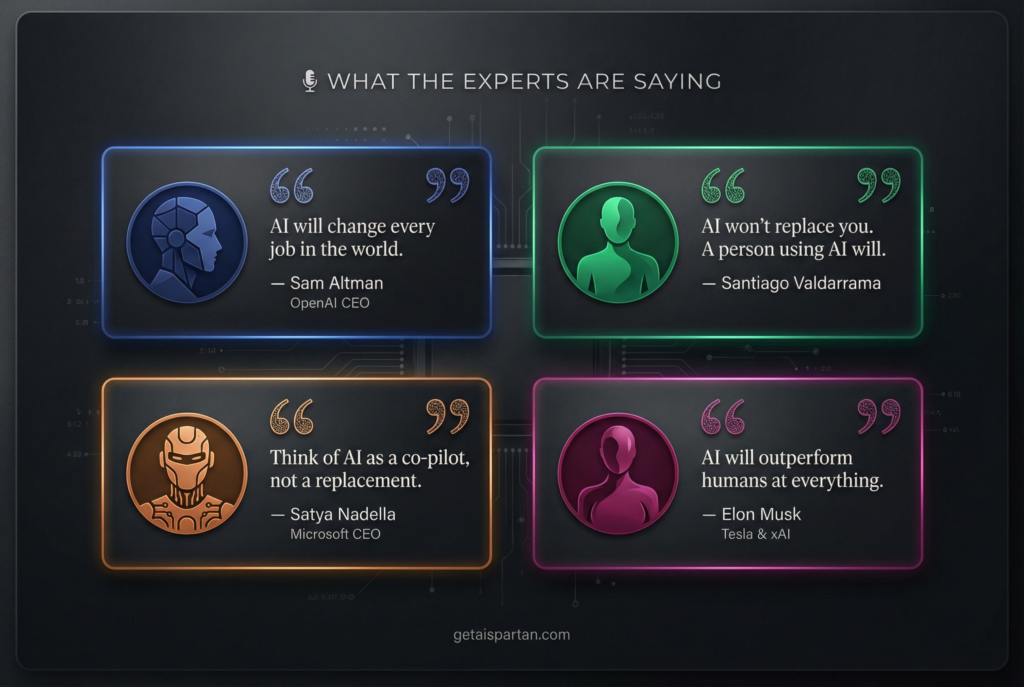
The AI jobs debate features passionate voices on all sides. Here’s what the most influential figures are saying:
“AI will eventually outperform humans at everything. We need to plan for a world where many current jobs don’t exist.”
— Elon Musk, CEO of Tesla & xAI
“AI is not going to replace you. A person using AI is going to replace you.”
— Santiago Valdarrama, AI educator (widely cited)
“We think the best way to think about AI is as a co-pilot, not a replacement. The most successful deployments are augmenting humans.”
— Satya Nadella, CEO of Microsoft
“AI will change every job in the world. It will probably eliminate some. But it will also create new ones, and the ones that remain will be better, more interesting, and more human.”
— Sam Altman, CEO of OpenAI
“Almost every interaction I have with our front-line workers suggests they want these tools. They don’t see AI as a threat — they see it as help.”
— Arvind Krishna, CEO of IBM
The McKinsey Global Institute takes a measured position:
while 400-800 million workers globally may need to find new occupations by 2030, the net impact on total employment will likely be neutral to positive — if societies invest in reskilling.
The contrarian view from economists like David Autor (MIT) argues that historical patterns consistently show technology creating more jobs than it destroys, and that we systematically overestimate automation’s speed while underestimating human adaptability.
The bottom line from experts? Disruption is real and accelerating, but catastrophe isn’t inevitable. Preparation is everything.