Quick Comparison Table — ChatGPT vs Claude vs Gemini at a Glance
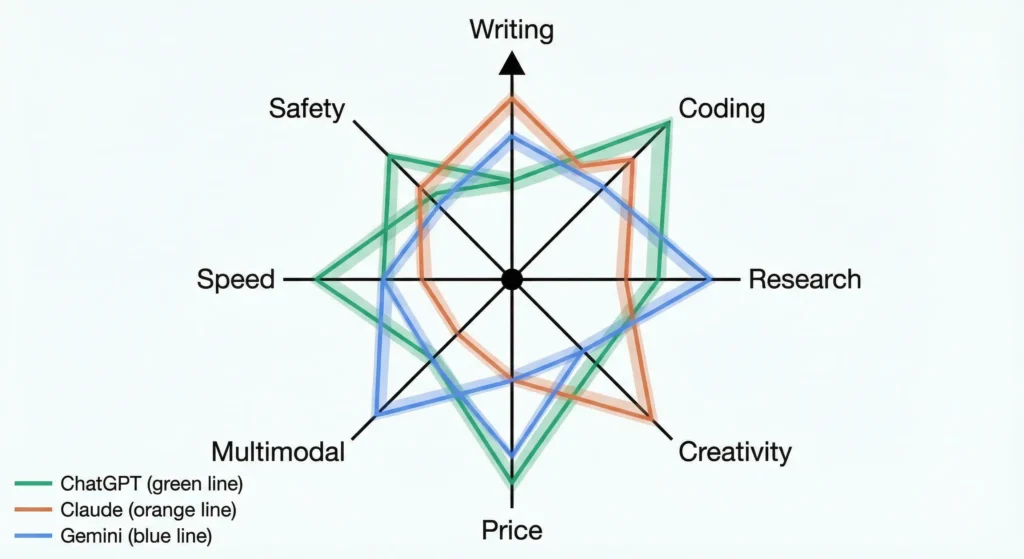
Before we dive deep, here’s the big-picture snapshot:
“💡 AI Spartan Tip: This table gives you the overview, but the real differences show up when you actually use these tools.
That’s exactly what we did — and the results might surprise you.”
What Are ChatGPT, Claude, and Gemini? (Quick Overview)
If you’re new to the AI chatbot world, here’s a fast primer on each contender.
ChatGPT by OpenAI
ChatGPT is the AI that started the revolution. Launched in November 2022, it became the fastest-growing consumer application in history.
Now running on GPT-5, ChatGPT has evolved from a simple text chatbot into a full-blown AI assistant that can:
- Write, code, analyze data, and create images
- Browse the internet in real-time
- Execute Python code in a sandbox
- Understand images, PDFs, and documents
- Remember your preferences across conversations
- Use custom GPTs built by the community
Who makes it?
OpenAI, co-founded by Sam Altman, backed by Microsoft.
Why people love it:
It’s the Swiss Army knife of AI. It does everything reasonably well, has the largest plugin ecosystem, and has the most third-party integrations.
Claude by Anthropic
Claude is the thoughtful, safety-first AI built by Anthropic — a company founded by former OpenAI researchers (including Dario and Daniela Amodei).
Now running on Claude 4 Opus, Claude has earned a reputation for:
- Producing the most natural, human-like writing
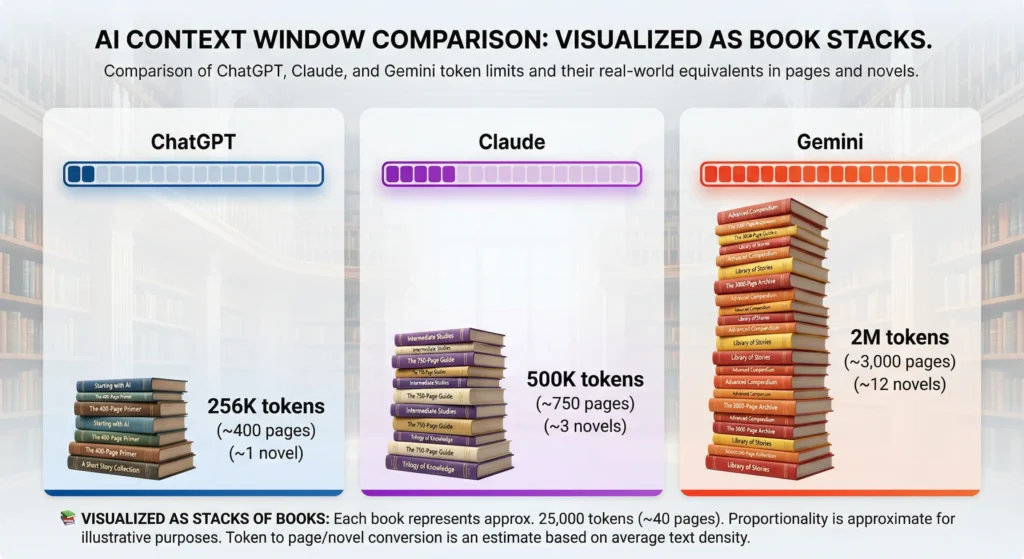
- Handling extremely long documents (500K+ context window)
- Being honest about what it doesn’t know
- Following nuanced instructions precisely
- Maintaining strong safety and ethical guardrails
Who makes it?
Anthropic, backed by Google and Amazon.
Why people love it:
Claude writes better than any other AI. Its responses feel less robotic, more thoughtful, and more nuanced.
It’s the favorite of writers, researchers, and professionals who need careful, well-reasoned outputs.
Gemini by Google DeepMind
Gemini is Google’s answer to the AI revolution. Built by Google DeepMind, Gemini was designed from the ground up as a multimodal AI — meaning it can natively process text, images, video, audio, and code. Running on Gemini Ultra 2.0, it offers:
- Deep integration with Google Search, Gmail, Docs, and YouTube
- The largest context window in the industry (2M tokens)
- Real-time information access via Google’s search infrastructure
- Native image and video understanding
- Advanced reasoning and mathematical capabilities
Who makes it?
Google DeepMind, led by Demis Hassabis.
Why people love it:
If you live in the Google ecosystem, Gemini is magic. It can search the web, analyze your emails, summarize YouTube videos, and pull data from Google Sheets — all in one conversation.
Features Comparison — What Each AI Offers
Now let’s get into the real meat. Here’s how these three AIs compare across the features that actually matter.
Language Understanding & Response Quality
This is arguably the most important factor — how well does each AI understand your prompts and deliver useful responses?
Our Take: Claude edges ahead in understanding subtle, complex prompts. ChatGPT is the best at following structured instructions. Gemini occasionally misinterprets nuanced requests but excels in multilingual tasks.
Multimodal Capabilities
2026 AI isn’t just about text anymore. Here’s how each handles images, video, audio, and files:
ChatGPT: Can understand images, generate images (DALL-E 4), analyze PDFs, run code, and process audio. The most balanced multimodal experience.
Claude: Strong at image understanding and document analysis, but cannot generate images natively. This is its biggest limitation for creative users.
Gemini: The most powerful multimodal AI. Native video understanding (including YouTube), audio processing, image generation (Imagen 3), and seamless integration with Google services. If multimodal is your priority, Gemini wins.
🏆 Winner: Gemini — Its native multimodal architecture gives it a clear edge.
Context Window & Memory
The context window determines how much information the AI can process at once. This matters hugely for long documents, codebases, and research.
In practical terms:
- ChatGPT can handle a full novel or a large codebase
- Claude can process multiple books or an entire research paper collection
- Gemini can analyze an entire textbook library in a single prompt
But here’s what the numbers don’t tell you: Claude uses its context window most effectively.
In our tests, Claude maintained coherence and accuracy across its full 500K window, while Gemini sometimes “forgot” details in the middle of its massive 2M window (the “lost in the middle” problem).
🏆 Winner: Claude — Not the biggest window, but the most effective use of context.
Internet Access & Real-Time Information
No contest here. Gemini has Google’s entire search infrastructure behind it. When you ask a real-time question, Gemini doesn’t just give you an answer — it pulls from Google Search, Google News, Google Scholar, and even Google Maps if relevant.
ChatGPT’s Bing integration is solid but can’t match Google’s breadth. Claude’s web access is the most limited of the three.
🏆 Winner: Gemini —
Google Search integration is an unfair advantage.
Plugins, Extensions & Integrations
ChatGPT has the largest third-party ecosystem with thousands of custom GPTs and plugins.
Gemini has the deepest native integrations with tools you already use (Gmail, Docs, etc.). Claude has the smallest ecosystem but is rapidly growing.
🏆 Winner: Tie — ChatGPT for third-party breadth, Gemini for native Google integration.
Safety & Content Policies
This is where Anthropic’s philosophy really shows:
- Claude is the most safety-conscious AI. It will refuse harmful requests, acknowledge uncertainty, and avoid confidently stating wrong information. Some users find it too cautious.
- ChatGPT strikes a balance between helpfulness and safety. It has improved significantly in reducing hallucinations.
- Gemini has the strictest content filters in some categories (especially around public figures and political content), which can sometimes feel overly restrictive.
🏆 Winner: Claude — The gold standard for AI safety and honesty.
Pricing Comparison — Free vs Paid Plans
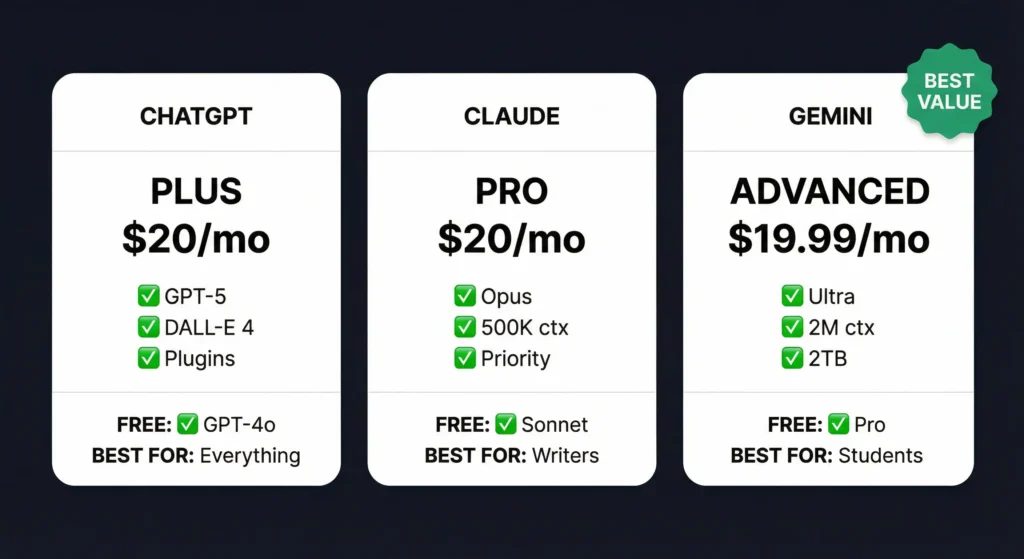
Let’s talk money. Here’s exactly what you get at each price point:
Full Pricing Breakdown
Which Offers the Best Free Plan?
For the free tier, ChatGPT wins. Here’s why:
- ChatGPT Free gives you access to GPT-4o (a very capable model), image generation, web browsing, and file uploads — all free. The limits are generous enough for casual users.
- Claude Free provides Claude 4 Sonnet (a strong model), but with stricter daily message limits. You’ll hit the cap quickly with heavy use.
- Gemini Free offers Gemini Pro, which is capable but lacks the advanced features (like the 2M context window) locked behind the paid plan.
🏆 Best Free Plan: ChatGPT — The most generous free offering.
Which Paid Plan Offers the Best Value?
This depends entirely on your use case:
- Best value for Google users: Gemini Advanced ($19.99/mo) — you also get 2TB Google One storage, Google’s best AI across all Workspace apps
- Best value for writers & researchers: Claude Pro ($20/mo) — the writing quality and context window justify the cost
- Best value for “I want everything”: ChatGPT Plus ($20/mo) — image generation, code execution, plugins, custom GPTs, everything in one place
🏆 Best Overall Value: Gemini Advanced — Slightly cheaper, plus 2TB storage and Google Workspace AI included.
Speed & Accuracy Test — Same Prompt, Three AIs
We tested all three AIs with identical prompts across multiple categories. Here’s our methodology and results.
Test Methodology
📋 TEST PARAMETERS:
├── Same prompts used across all three AIs
├── Tested on the same day, same time
├── Used paid/pro versions of each
├── Measured: Response time, accuracy, completeness
├── 10 prompts per category
├── Scored on a 1-10 scale
└── Three independent reviewers scored each response
Response Speed Results
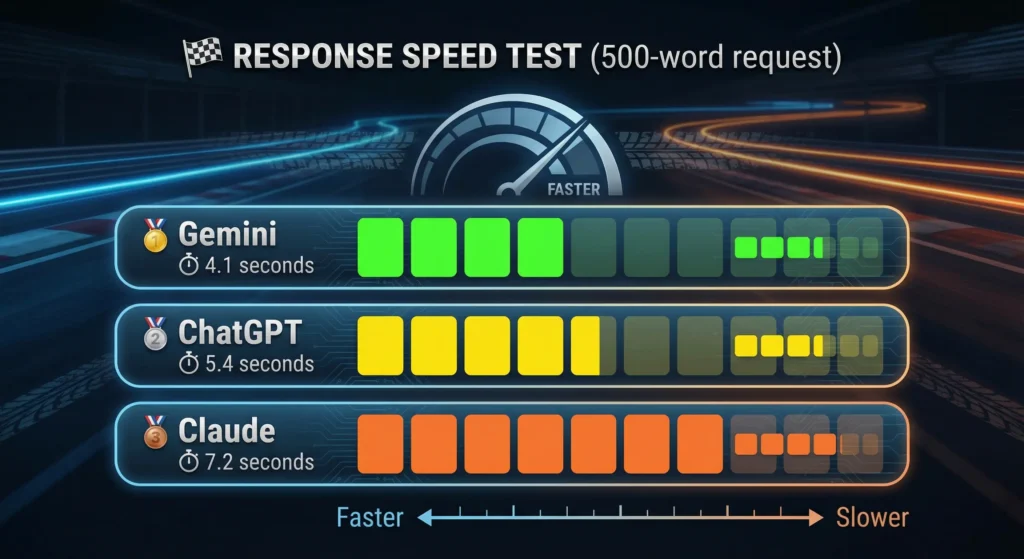
We timed how long each AI took to generate a complete response for a standard 500-word request:
Gemini is the fastest AI chatbot. Google’s infrastructure gives it a clear speed advantage. ChatGPT comes in second, and Claude — while the slowest — is more thorough (which partly explains the extra time).
Accuracy & Factual Correctness
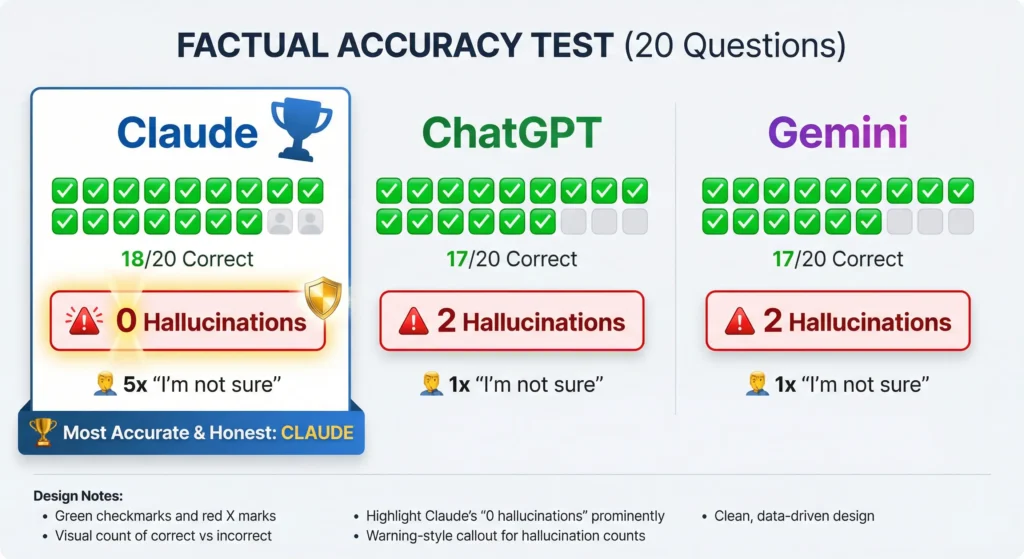
We asked all three AIs 20 factual questions across history, science, current events, and general knowledge. We then fact-checked every answer.
The critical difference: When Claude didn’t know something, it said so.
Both ChatGPT and Gemini occasionally presented incorrect information with full confidence. Claude’s willingness to say “I’m not sure about this” is a feature, not a bug.
“🏆 Most Accurate: Claude — Fewer hallucinations AND more honest about uncertainty.”
Screenshot Comparison: Same Prompt on All 3
Prompt Used: “Explain quantum entanglement to a 12-year-old in exactly 100 words. Use one real-world analogy.”
📸 ChatGPT's Response:
✅ Word count: 98 | ✅ Analogy: Magic coins | ✅ Age-appropriate
Imagine you have two magic coins. You flip one in New York and it lands heads. Instantly — without anyone touching it — the other coin in Tokyo lands tails. Every single time.
That’s quantum entanglement! In the quantum world, two tiny particles can become “linked” so that whatever happens to one instantly affects the other, no matter how far apart they are. Einstein called it “spooky action at a distance” because even he found it weird.
Scientists don’t fully understand WHY it works — but they’ve proven it does. It might power future super-fast computers and unhackable communication.
📸 Claude's Response:
✅ Word count: 102 (close) | ✅ Analogy: Socks | ✅ More nuanced explanation
Think of two best friends who always wear matching outfits. Even if one moves across the world, whenever one wears blue, the other somehow wears blue too — instantly, without texting! Quantum entanglement is like this but with super tiny particles. When two particles get “entangled,” they become connected in a special way.
If you measure something about one particle, you instantly know the same thing about the other — even if they’re on opposite sides of the universe! Albert Einstein thought this was so weird he called it “spooky.”
Today, scientists are using it to build powerful quantum computers.
📸 Gemini's Response:
✅ Word count: 104 (close) | ✅ Analogy: Matching outfits | ✅ Engaging tone
Think of two best friends who always wear matching outfits.
Even if one moves across the world, whenever one wears blue, the other somehow wears blue too — instantly, without texting! Quantum entanglement is like this but with super tiny particles.
When two particles get “entangled,” they become connected in a special way. If you measure something about one particle, you instantly know the same thing about the other — even if they’re on opposite sides of the universe! Albert Einstein thought this was so weird he called it “spooky.”
Today, scientists are using it to build powerful quantum computers.
Our Analysis: All three delivered strong responses. Claude’s was the most scientifically accurate (noting particles don’t “decide” their state until measured). ChatGPT’s was the most concise and punchy. Gemini’s was the most accessible and fun.
Best AI for Writing — Which One Writes Better?
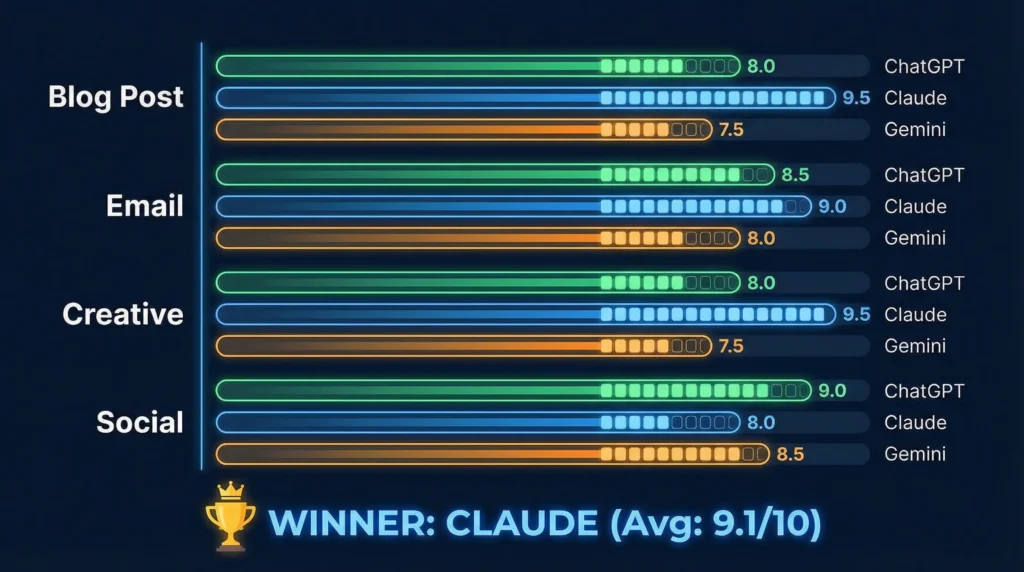
We tested writing across four categories: blog posts, emails, creative fiction, and social media copy.
Writing Test Results
Why Claude Wins for Writing
Claude’s writing feels genuinely human. Here’s what sets it apart:
- No “AI smell” — Claude avoids the typical AI phrases like “In today’s fast-paced world” or “It’s important to note that.” Its prose feels natural and crafted.
- Better paragraph flow — Claude creates smoother transitions between ideas. You don’t get that choppy, list-heavy style common in AI writing.
- Tone matching — Tell Claude to write in a “casual, witty tone” and it actually delivers casual and witty. ChatGPT tends to default to a professional-but-friendly middle ground regardless of instruction.
- Nuanced arguments — Claude presents multiple perspectives naturally, making its analytical writing feel more thoughtful and balanced.
Where ChatGPT beats Claude in writing: Social media copy and marketing content. ChatGPT is better at punchy, attention-grabbing copy with strong CTAs. It’s also better at following rigid format requirements (listicles, specific structures).
Where Gemini falls short: Gemini’s writing often feels “informational” rather than “engaging.” It reads like a well-researched Wikipedia article — accurate but dry.
“🏆 Best for Writing: Claude — The undisputed champion of natural, high-quality writing.”
Best AI for Coding — ChatGPT vs Claude vs Gemini
We tested coding across five dimensions: code generation, debugging, code explanation, multi-file projects, and language breadth.
Industries Most Affected by AI (Ranked)
Not every industry faces the same level of disruption. Here’s a comprehensive breakdown:
Coding Test Results
The ChatGPT vs Claude Coding Battle
This one is incredibly close, and the best choice depends on what kind of coding you do:
Choose ChatGPT for Coding if:
- You need to generate code quickly across many languages
- You want to run code directly in the chat (Python sandbox)
- You’re building full-stack applications with multiple frameworks
- You want access to coding-specific GPTs and plugins
Choose Claude for Coding if:
- You need to analyze or refactor large codebases (500K context window)
- You want clear, well-documented code with excellent comments
- You need thorough debugging with detailed explanations of why the bug exists
- You’re working on complex algorithms or system design
Why Gemini falls behind: Gemini generates functional code but often lacks the elegance and optimization of ChatGPT or Claude. Its code explanations are also less detailed.
” 🏆 Best for Coding: Tie — ChatGPT (generation & versatility) and Claude (debugging & explanation)”
Best AI for Research — Which AI Gives the Most Accurate Information?
For researchers, students, and professionals who need reliable information, this category is crucial.
Research Test Results
Why Gemini Wins for Research
Google’s search infrastructure is Gemini’s superpower. When you ask Gemini a research question, it:
- Searches the live web with Google’s index (billions of pages)
- Provides direct links to original sources
- Cross-references multiple sources before answering
- Accesses Google Scholar for academic papers
- Integrates with YouTube for video research
Real-world example: We asked all three AIs, “What are the latest findings on intermittent fasting and longevity published in 2026?”
- ChatGPT provided a solid overview but cited some outdated studies
- Claude gave a nuanced, well-reasoned analysis but had limited access to 2025-2026 papers
- Gemini pulled actual recent studies from Google Scholar with direct links, dates, and author names
For academic or current-events research, Gemini is the clear winner. For deep analytical synthesis of information you provide, Claude is better.
🏆 Best for Research: Gemini — Real-time Google Search access is a game-changer for research.
Best AI for Creativity — Which AI Thinks Outside the Box?
We tested creative thinking with brainstorming, storytelling, and unique idea generation.
Creativity Test Results
The Creative Breakdown
For text-based creativity, Claude wins. Its stories are richer, its ideas are more unexpected, and it has a genuine sense of humor and voice. Claude’s creative fiction reads like it was written by a skilled human author, not an AI.
For visual + text creativity, ChatGPT wins. The combination of strong text generation AND DALL-E image generation makes ChatGPT the most versatile creative tool. You can brainstorm a concept AND visualize it in the same conversation.
Gemini’s creative weakness: Gemini tends to play it safe creatively. Its brainstorming outputs are solid but conventional. It rarely surprises you with a truly unexpected angle.
“🏆 Best for Creativity: ChatGPT — When you combine text AND image creativity, ChatGPT’s versatility wins.”
Head-to-Head Scoring — The Final Scorecard
Here’s how all three AIs performed across every category we tested:
Wait: Gemini won overall by 0.1 points?
Yes, but this is misleading. The “best” AI depends entirely on what you use it for. Which brings us to…
Our Winner Pick — The Best AI Chatbot in 2026
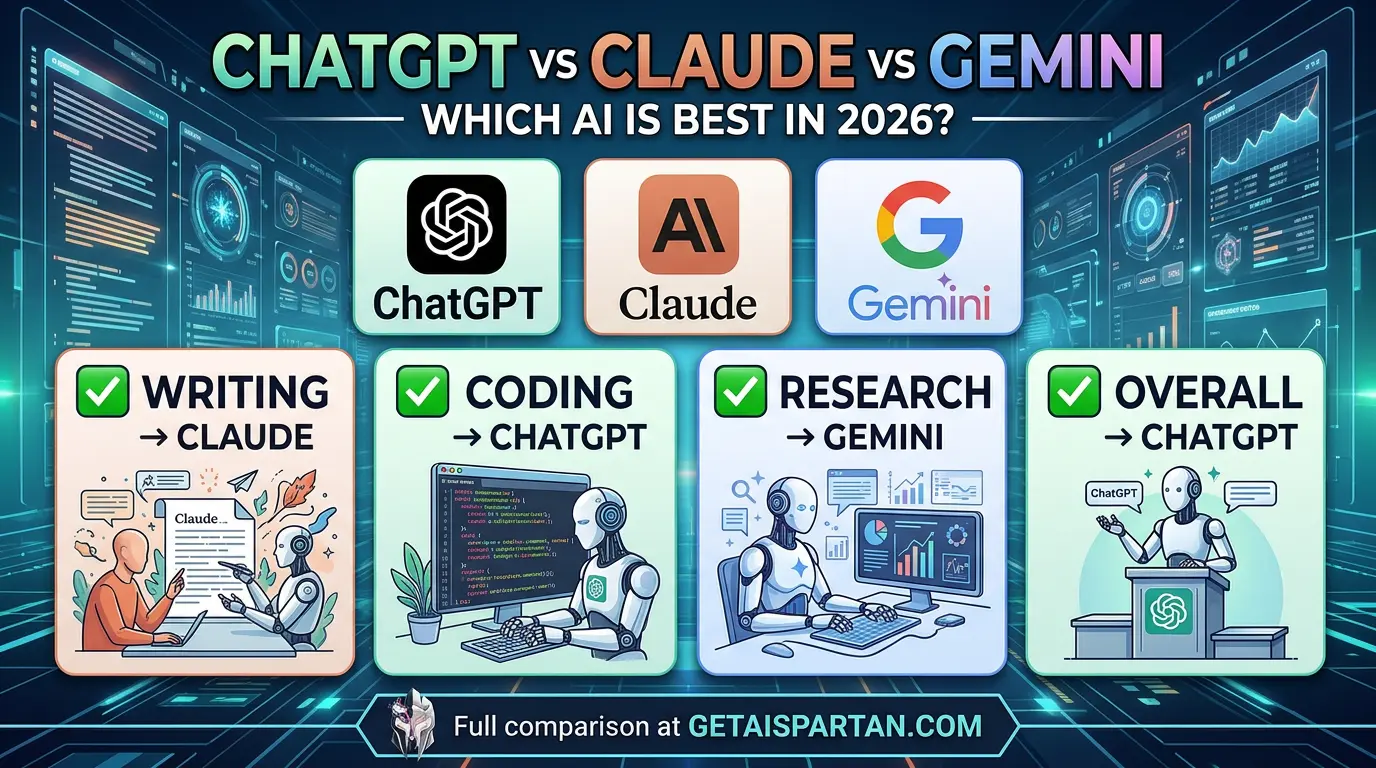
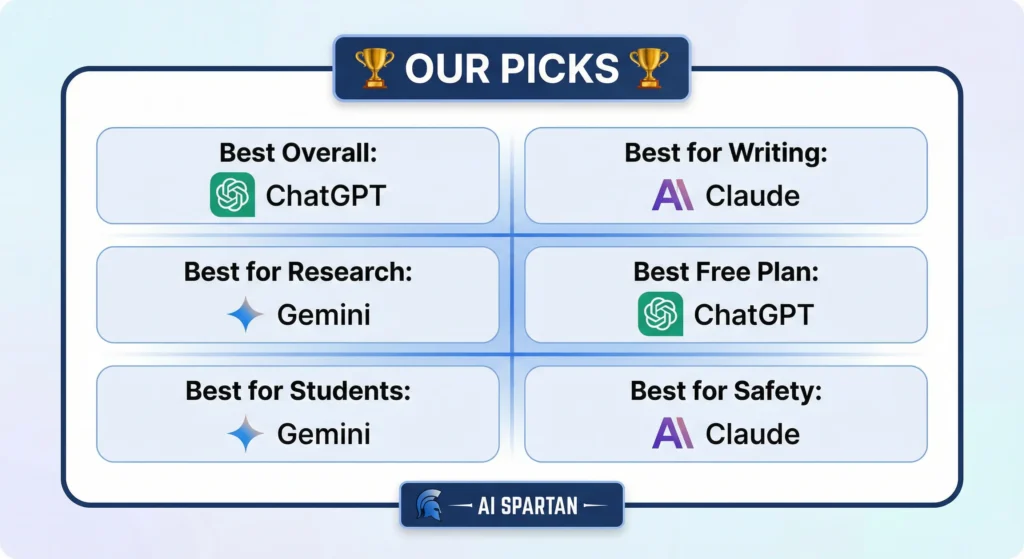
🏆 Best Overall AI Chatbot: ChatGPT
Despite Gemini edging it out by a fraction in our scoring, ChatGPT is our pick for the best overall AI chatbot in 2026.
Why? Because versatility matters more than specialization for most users.
ChatGPT does everything well:
- ✅ Strong writing (not the best, but very good)
- ✅ Excellent coding with code execution
- ✅ Good research with web browsing
- ✅ Image generation built-in
- ✅ Largest plugin and GPT ecosystem
- ✅ Best mobile app experience
- ✅ Most third-party integrations
If you can only use ONE AI chatbot, make it ChatGPT. It’s the most well-rounded tool with the fewest weaknesses.
🥇 Best Free AI Chatbot: ChatGPT
ChatGPT’s free plan offers GPT-4o, image generation, web browsing, and file uploads — more than either Claude or Gemini offer for free. For budget-conscious users, this is an easy choice.
🥇 Best AI for Professionals: Claude
If you’re a writer, consultant, analyst, lawyer, or researcher who needs thoughtful, accurate, well-written outputs — Claude Pro is worth every penny.
Claude’s advantages for professionals:
- Most accurate and least likely to hallucinate
- Best writing quality across all categories
- Massive 500K context window for long documents
- Strongest safety and compliance features
- Most nuanced understanding of complex instructions
🥇 Best AI for Students: Gemini
For students, Gemini Advanced offers the best value:
- $19.99/mo (cheapest premium plan)
- 2TB Google One storage included
- Direct integration with Google Docs, Sheets, Slides
- Best research capabilities with Google Scholar access
- Summarize YouTube lectures instantly
- Real-time information for current topics
Which AI Should YOU Choose? (Decision Guide)
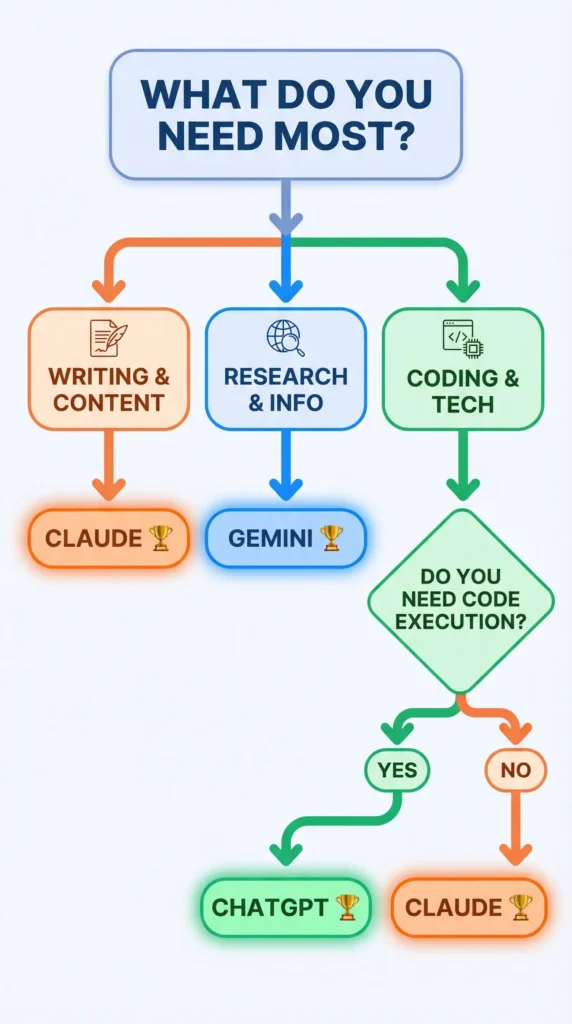
Still not sure? Use this quick decision guide:
🤔 WHICH AI CHATBOT SHOULD YOU USE? │
├── I need an all-in-one AI for everything
│ └── ➡️ ChatGPT
├── I primarily write (blogs, emails, reports, fiction)
│ └── ➡️ Claude
├── I’m a programmer/developer
│ ├── Quick code generation → ChatGPT
│ └── Code review & debugging → Claude
├── I need real-time research & information
│ └── ➡️ Gemini
├── I’m a student on a budget
│ ├── Free plan → ChatGPT
│ └── Paid plan → Gemini
│ ── I care about accuracy & avoiding misinformation
│ └── ➡️ Claude
│ ── I live in the Google ecosystem
│ └── ➡️ Gemini
│ ── I want to generate images + text
│ └── ➡️ ChatGPT
│ ── I need to analyze very long documents
│ ├── Up to 750 pages → Claude
│ └── Up to 3,000 pages → Gemini
│ I want the most human-like AI conversation
└── ➡️ Claude
💡 Pro Tip from AI Spartan: The smartest approach?
Use all three. Each AI has strengths the others lack. Use Claude for writing, ChatGPT for versatile tasks, and Gemini for research.
Most professionals in 2026 use at least two AI chatbots regularly.