
• Our Office
  • 72 Oceanview Drive Los Angeles,
    CA 90045 USA

What is Artificial Intelligence? A Simple Guide for Beginners (2026)

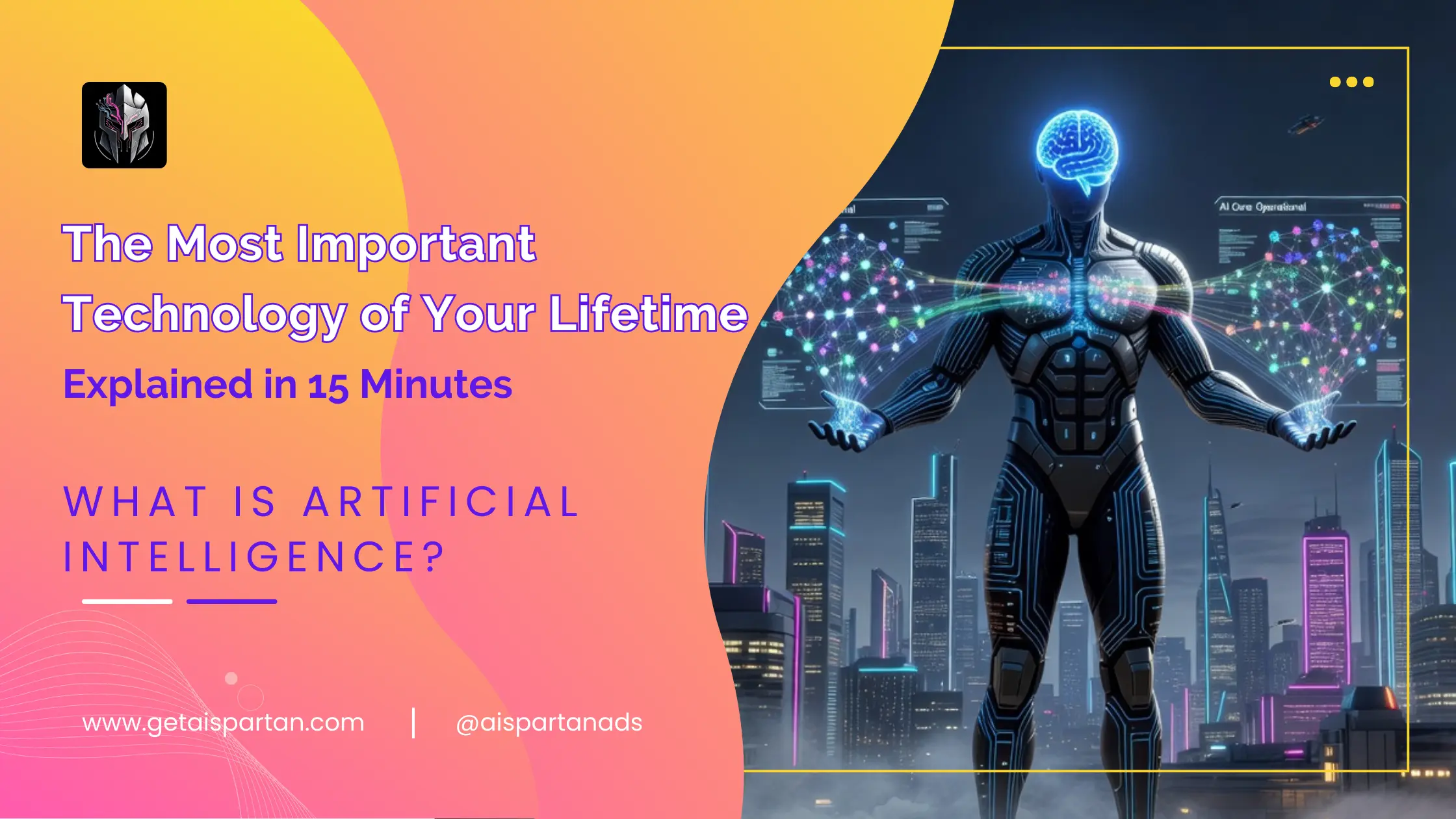
What is artificial intelligence - digital brain made of neural network connections surrounded by AI application icons including healthcare, transportation, and communication symbols - beginner guide 2026

INTRODUCTION

You probably used artificial intelligence at least 20 times today — and you didn’t even realize it.


When you unlocked your phone with your face this morning? That was AI. When Google finished typing your search query before you did? AI again. When Netflix somehow knew you’d love that obscure documentary about octopuses? You guessed it — artificial intelligence.


Yet when someone asks, “What is artificial intelligence?” most people freeze. They picture Terminator robots or some genius-level computer science concept that’s way above their pay grade.


Here’s the truth: AI isn’t as complicated as you think. And in 2026, understanding it isn’t optional anymore — it’s essential.

Whether you’re a student exploring career paths, a professional wondering if AI will take your job, or simply a curious human who wants to understand the technology reshaping our world, this guide is for you.

No jargon. No PhD required. Just clear, simple explanations with real examples.


In a hurry? Artificial intelligence (AI) is technology that enables machines to mimic human intelligence — learning from data, recognizing patterns, making decisions, and improving over time. Think of it as teaching computers to “think” rather than just follow instructions.


Let’s break it all down. ⬇️

Table of Contents

What is Artificial Intelligence? (Simple Definition)

AI in Simple Words (The Grandma-Friendly Explanation)

Imagine you’re teaching a child to recognize dogs.


You don’t write them a 500-page rulebook that says: “A dog has four legs, fur, a tail, two eyes, a snout measuring between 5-30 centimeters…”


Instead, you show them hundreds of dogs. Big dogs. Small dogs. Fluffy dogs. Skinny dogs. Eventually, the child just gets it. They can spot a dog they’ve never seen before and say, “That’s a dog!”


That’s essentially how AI works.

Instead of programming a computer with every possible rule, we feed it tons of data and let it figure out the patterns on its own. The computer “learns” — just like that child learned what a dog looks like.


🔑 Simple Definition: Artificial intelligence is the ability of a computer or machine to perform tasks that normally require human intelligence — like understanding language, recognizing images, making decisions, and learning from experience.

The Technical Definition (For the Curious Minds)

If you want the textbook version, here it is:


Artificial intelligence is a branch of computer science focused on building systems capable of performing tasks that typically require human cognitive functions — including perception, reasoning, learning, problem-solving, language understanding, and decision-making.


AI systems achieve this by processing massive amounts of data, identifying patterns within that data, and using those patterns to make predictions or decisions with minimal human intervention.

The Key Difference: Traditional Programming vs. AI

Here’s what makes AI fundamentally different from regular software:

Traditional ProgrammingArtificial Intelligence
InputRules + DataData + Expected Output
ProcessFollow exact instructionsLearn patterns from data
OutputPredetermined resultPredictions/Decisions
AdaptabilityCan't improve on its ownImproves with more data
ExampleCalculatorChatGPT

A Brief History of Artificial Intelligence {#history}

AI isn’t new. The dream of intelligent machines has been around for decades. Here’s how we got to where we are in 2026.

The Birth of AI (1950s-1960s)

The story of artificial intelligence begins with one question from a brilliant British mathematician named Alan Turing. In 1950, he published a groundbreaking paper asking: “Can machines think?”


He proposed what we now call the Turing Test — if a machine could carry on a conversation so well that a human couldn’t tell they were talking to a machine, it could be considered “intelligent.”

Then in 1956, a group of scientists gathered at Dartmouth Conference. It was here that the term “Artificial Intelligence” was officially coined by John McCarthy. This moment is widely considered the birth of AI as a field of study.


Early excitement was through the roof. Scientists believed truly intelligent machines were just around the corner.


⏱️ Fun Fact: In 1958, the New York Times reported that a machine called the “Perceptron” (an early neural network) would eventually “be able to walk, talk, see, write, reproduce itself, and be conscious of its existence.” That was… a bit optimistic.

AI Winters: When the Hype Died (1970s-1990s)

Reality hit hard.

Early computers simply didn’t have enough processing power or data to deliver on AI’s promises. Funding dried up. Researchers moved on. These periods of disillusionment became known as “AI Winters” — and there were two major ones:


  • First AI Winter (1974-1980): Governments cut funding after AI failed to meet wild expectations


  • Second AI Winter (1987-1993): Expensive “expert systems” collapsed, and investors lost faith again


But AI didn’t die. It was quietly evolving in labs and universities, waiting for technology to catch up.

The Comeback: Big Data + Better Hardware (2000s-2010s)

Three things changed everything:


  1. Massive amounts of data (the internet created more data than ever in history)
  2. Powerful GPUs (graphics cards originally built for gaming turned out to be perfect for AI)
  3. Better algorithms (researchers developed smarter approaches to machine learning)


Key milestones:


  • 2011: IBM’s Watson defeated human champions on Jeopardy!
  • 2012: Google’s AI learned to recognize cats in YouTube videos (a bigger deal than it sounds)
  • 2016: Google DeepMind’s AlphaGo defeated the world champion in Go — a game many believed was too complex for AI

The AI Explosion (2020-2026)

And then came the generative AI revolution.


  • 2022: ChatGPT launched and reached 100 million users in just 2 months — the fastest-growing consumer application in history
  • 2023: GPT-4, Google Bard (Gemini), Midjourney, and dozens of AI tools transformed how people work and create
  • 2024: AI agents began handling complex multi-step tasks autonomously; AI video generation became mainstream
  • 2025: Multimodal AI systems that seamlessly process text, images, audio, and video became the new standard
  • 2026: AI is now embedded in virtually every industry, from healthcare diagnostics to legal research to creative production


We are currently living through the most significant technological transformation since the internet itself.

Types of Artificial Intelligence {#types}

Not all AI is created equal. Scientists classify artificial intelligence into three main types based on their capabilities.

Type 1: Narrow AI (Weak AI) — The Only AI That Exists Today

Narrow AI is designed to do one specific task really, really well — but that’s all it can do.


It can beat you at chess but can’t make you a sandwich. It can recommend the perfect Netflix show but can’t explain why you’re feeling sad today.


Examples of Narrow AI:

  • ✅ Siri and Alexa (voice assistants)
  • ✅ Google Search algorithms
  • ✅ Netflix and Spotify recommendations
  • ✅ ChatGPT and other language models
  • ✅ Tesla’s Autopilot
  • ✅ Spam email filters
  • ✅ Face recognition on your phone


🔑 Key point: Every single AI application you use today — including ChatGPT, no matter how impressive it seems — is Narrow AI. It’s incredibly powerful within its domain but doesn’t possess general understanding or consciousness.

A traditional program is like a recipe — follow the steps exactly and you get the same dish every time.


AI is like a chef — it studies thousands of recipes, understands flavor combinations, and eventually creates entirely new dishes on its own.

Type 2: General AI (Strong AI / AGI) — The Big Goal

  Artificial General Intelligence (AGI) would be a machine that can understand, learn, and apply intelligence across any task — just like a human brain.


An AGI system could:

  • Learn to cook by watching a YouTube video
  • Write a novel AND fix your car engine
  • Understand emotions, sarcasm, and cultural context
  • Transfer knowledge from one domain to a completely different one
  •  

Does AGI exist yet? 

No. Not even close — although in 2026, the debate is more heated than ever. Some researchers at leading AI labs claim we could see early forms of AGI within the next decade. Others say it’s still 50+ years away.

Type 3: Super AI (Superintelligence) — Science Fiction (For Now)

Artificial Superintelligence (ASI) would be an AI that surpasses human intelligence in every single way — creativity, problem-solving, emotional intelligence, scientific discovery — everything.


This is the stuff of science fiction movies. Think Skynet from Terminator or Ultron from The Avengers.

Does it exist? Absolutely not. And most experts believe it’s either:


  • Decades (or centuries) away
  • May never happen at all
  • Needs to be approached with extreme caution if it ever does

Quick Comparison Table

FeatureNarrow AI (Weak)General AI (AGI)Super AI (ASI)
CapabilityOne specific task|Any human-level task|Surpasses all humans
Exists Today?✅ Yes❌ No❌ No
Self-Aware?❌ NoPotentiallyTheoretically yes
ExampleChatGPT, SiriLike a human brainBeyond human comprehension
TimelineNOW10-50+ years (debated)Unknown / Speculative
Risk LevelLow-MediumMedium-HighPotentially existential

The bottom line: When we talk about AI in 2026, we are talking about Narrow AI — which is already powerful enough to reshape entire industries.

How Does Artificial Intelligence Work? (Simple Explanation) {#how-it-works}

Let’s demystify how AI actually works behind the scenes. No computer science degree needed — I promise.

The Simple 3-Step Process

Think of AI like training a dog. Seriously. The analogy works perfectly.

Step 1: Data Collection (Give It Food 🍖)

Just like you’d show a puppy many different examples of what “sit” looks like before it understands, AI needs thousands or millions of examples to learn from.


  • Want AI to recognize cats? → Feed it millions of cat photos
  • Want AI to understand English? → Feed it billions of sentences
  • Want AI to detect diseases? → Feed it thousands of medical scans
  • Data is AI’s food. The more quality data it gets, the smarter it becomes.

Step 2: Training (Learning Patterns 🧠)

Once AI has the data, it starts looking for patterns.


This is where the “magic” happens. Using mathematical algorithms, the AI analyzes all that data and identifies relationships, trends, and structures that might be invisible to the human eye.


For example:


  • It notices that cat photos usually contain pointy ears, whiskers, and fur
  • It discovers that when people say “I’m feeling blue,” they don’t literally mean they turned blue
  • It finds that certain cell patterns in medical scans correlate with specific diseases


The AI gets tested repeatedly. When it’s right, the algorithm reinforces that pattern. When it’s wrong, it adjusts. This is called training — and it’s very similar to how humans learn through trial and error.

Step 3: Prediction / Decision (The Output 🎯)

Once the AI is trained, it can take new data it’s never seen before and make predictions or decisions.


Show it a photo it’s never seen → “That’s a cat — 98% confidence.”
Give it a sentence in English → It translates to perfect French.
Feed it a medical scan → “This shows early signs of pneumonia.”

That’s it. That’s fundamentally how AI works.

A Visual Summary

📥 INPUT (Data)

🧠 PROCESSING (Pattern Recognition + Learning)

📤 OUTPUT (Prediction / Decision / Action)

🔄 FEEDBACK (Was it right? Adjust and improve)

The more data it processes, the more feedback it receives, and the more accurate it becomes. This continuous improvement loop is what makes AI so powerful.

AI vs Machine Learning vs Deep Learning: What's the Difference? {#comparison}

These three terms get thrown around interchangeably, which causes massive confusion. Let’s sort this out once and for all.

The Russian Nesting Doll Analogy 🪆

Think of it like Russian nesting dolls:

🔵 ARTIFICIAL INTELLIGENCE (Biggest doll — the entire field)

└── 🟢 MACHINE LEARNING (Medium doll — a subset of AI)

           └── 🔴 DEEP LEARNING (Smallest doll — a subset of ML)

What is Machine Learning (ML)?

Machine Learning is a type of AI where the system learns from data without being explicitly programmed for every scenario.

Instead of writing code that says “IF this, THEN that” for every possible situation, you give the system data and let it figure out the rules on its own.

Three types of Machine Learning:

TypeHow It WorksExample
Supervised LearningLearns from labeled data (you give it answers to learn from)Email spam detection
Unsupervised LearningFinds hidden patterns in unlabeled dataCustomer segmentation
Reinforcement LearningLearns by trial and error with rewards/penaltiesGame-playing AI, robotics

What is Deep Learning (DL)?

Deep Learning is a type of Machine Learning that uses artificial neural networks — structures loosely inspired by the human brain.


These networks have multiple “layers” (that’s why it’s called “deep”) that can process information in increasingly complex ways.


Deep Learning is the technology behind:

  • 🗣️ Voice assistants understanding your speech
  • 📷 Face recognition on your phone
  • 💬 ChatGPT and other large language models
  • 🎨 AI-generated images (Midjourney, DALL-E)
  • 🚗 Self-driving car vision systems

The Complete Comparison

Artificial IntelligenceMachine LearningDeep Learning
What is it?Broad field of intelligent machinesSubset of AI that learns from dataSubset of ML using neural networks
ScopeWidestNarrowerMost specific
Data NeededVariesModerate amountsMassive amounts
Human InterventionCan be highModerateMinimal
Computing PowerVariesModerateVery high
ExampleAny smart systemSpam filter learningChatGPT, facial recognition

How to Remember It

All Deep Learning is Machine Learning, and all Machine Learning is AI — but NOT all AI is Machine Learning, and NOT all Machine Learning is Deep Learning

Simple version:

  • AI = the dream (making smart machines)
  • ML = the method (learning from data)
  • DL = the breakthrough (neural networks that learn deeply)

Real-World Examples of AI in 2026 {#examples}

AI isn’t some futuristic concept — it’s everywhere right now. Here are the most impactful real-world applications in 2026.

📱 AI in Your Phone

Every modern smartphone is packed with AI:

  • Face ID / Face Unlock — AI recognizes your face in milliseconds, even with a new haircut or glasses
  • Voice Assistants (Siri, Google Assistant) — Natural language processing AI understands your questions and responds conversationally
  • Autocorrect and Predictive Text — AI learns your writing style and suggests words before you type them
  • Computational Photography — AI enhances your photos automatically (night mode, portrait blur, HDR)

🏥 AI in Healthcare

This is where AI is saving lives — literally:

  • Disease Detection: AI systems now detect certain cancers from medical scans with accuracy matching or exceeding human doctors
  • Drug Discovery: AI has reduced the time to develop new medications from years to months
  • Personalized Treatment: AI analyzes your genetics, lifestyle, and medical history to recommend treatments tailored specifically to you
  • Mental Health: AI-powered chatbots provide 24/7 mental health support and early detection of depression
  • 💡 2026 Update: AI diagnostic tools are now approved and actively used in hospitals across 40+ countries. In radiology alone, AI assists in over 60% of scan analyses globally.

🎬 AI in Entertainment

  • Netflix / YouTube: AI recommendation engines determine 80% of what people watch on Netflix
  • Spotify / Apple Music: AI creates personalized playlists based on your listening habits, mood, and even time of day
  • Gaming: AI creates dynamic game worlds that adapt to how you play
  • Content Creation: Generative AI tools help create music, scripts, visual effects, and entire virtual environments

🚗 AI in Transportation

  • Self-Driving Vehicles: Companies like Waymo, Tesla, and Cruise operate autonomous vehicles in multiple cities
  • Traffic Management: AI optimizes traffic light timing to reduce congestion by up to 25%
  • Ride-Sharing: Uber and Lyft use AI for dynamic pricing, route optimization, and estimated arrival times
  • Aviation: AI assists pilots with navigation, fuel optimization, and predictive maintenance

📚 AI in Education

  • Personalized Learning: AI tutors adapt to each student’s pace, strengths, and weaknesses
  • Automated Grading: AI grades essays and assignments, giving teachers more time for actual teaching
  • Language Learning: Apps like Duolingo use AI to customize lessons for each user
  • Accessibility: AI provides real-time translation, captioning, and text-to-speech for students with disabilities

🤖 Generative AI (The 2024-2026 Revolution)

    • ChatGPT, Claude, Gemini → Generate human-like text, answer questions, write code
    • Midjourney, DALL-E → Create images from text descriptions
    • Sora, Runway → Generate videos from text prompts
    • Suno, Udio → Compose original music
    • GitHub Copilot → Write code alongside human programmers

      The biggest AI story of this era is generative AI — systems that create new content:

    • 🔥 By 2026, over 90% of online content is estimated to be AI-assisted in some form — from initial drafts to editing, optimization, and distribution.

How AI Affects Your Daily Life (A Day With AI) {#daily-life}

Let’s walk through a typical day to show you just how much AI is already woven into your life.

☀️ Morning (6:00 AM - 9:00 AM)

TimeActivityAI Involved
6:00 AMSmart alarm wakes you at the optimal sleep cycle✅ Sleep tracking AI
6:05 AMCheck phone with Face ID✅ Facial recognition AI
6:10 AMScroll news feed✅ Content recommendation AI
6:30 AMAsk Alexa about weather✅ Natural language processing
7:00 AMGPS navigation to work✅ Route optimization AI
7:30 AMEmail inbox auto-sorted, spam filtered✅ Classification AI
8:00 AMAutocorrect fixes typos in messages✅ Predictive text AI

🏢 Afternoon (12:00 PM - 5:00 PM)

TimeActivityAI Involved
12:00 PMFood delivery app suggests lunch✅ Recommendation AI
1:00 PMUse Google Translate for work document✅ Translation AI
2:00 PMVideo call with auto-background blur✅ Computer vision AI
3:00 PMOnline shopping — "You might also like..."✅ Recommendation AI
4:00 PMBank sends fraud alert for suspicious charge✅ Anomaly detection AI

🌙 Evening (6:00 PM - 10:00 PM)

TimeActivityAI Involved
6:00 PMSpotify plays your "Chill Evening" mix✅ Music recommendation AI
7:00 PMNetflix suggests a movie✅ Content recommendation AI
8:00 PMSmart thermostat adjusts temperature✅ Predictive AI
9:00 PMScroll social media (curated feed)✅ Content curation AI
10:00 PMSet smart alarm for tomorrow✅ Sleep optimization AI

The average person interacts with AI-powered systems 50-100+ times per day without even thinking about it.


You don’t need to understand the technology behind electricity to flip a light switch. Similarly, AI has become an invisible utility that powers modern life.

Common Myths About Artificial Intelligence {#myths}

❌ Myth 1: "AI Will Replace ALL Human Jobs"

The Reality: AI will transform jobs, not eliminate all of them.


Yes, AI will automate certain tasks — especially repetitive, routine ones. But history shows that technology creates more jobs than it destroys. The invention of the automobile eliminated horse-carriage jobs but created millions of jobs in manufacturing, maintenance, road construction, logistics, and more.


What will actually happen:

  • Some jobs will disappear (data entry, basic bookkeeping, simple customer service)
  • Many jobs will be augmented — AI handles the boring parts while humans focus on creative, strategic, and emotional tasks
  • Entirely new jobs will emerge that we can’t even imagine yet (just like “social media manager” didn’t exist 20 years ago


💡 The Real Threat: AI won’t replace you. A person who knows how to use AI will replace you. The key is to learn to work with AI, not compete against it.

❌ Myth 2: "AI is Conscious and Can Think Like Humans"

The Reality: Current AI has zero consciousness, feelings, or understanding.


When ChatGPT says “I think…” or “I feel…”, it’s using patterns from its training data — not actually thinking or feeling. It’s generating statistically probable text based on billions of examples.


AI doesn’t:

  • ❌ Understand what it’s saying
  • ❌ Have emotions or desires
  • ❌ Experience the world
  • ❌ Have self-awareness


It’s an incredibly sophisticated pattern-matching machine — nothing more, nothing less (for now).

❌ Myth 3: "AI is Always Right and Unbiased"

The Reality: AI can be spectacularly wrong and deeply biased.


AI learns from human-created data. If that data contains biases (and it almost always does), the AI will absorb and amplify those biases.


Real examples of AI bias:

  • Hiring algorithms that discriminated against women because they were trained on historically male-dominated hiring data
  • Facial recognition systems that were significantly less accurate for people with darker skin tones
  • Healthcare AI that recommended less care for Black patients due to biased training data
  • Remember: AI is only as good as the data it’s trained on. Garbage in = garbage out.

❌ Myth 4: "AI Will Take Over the World (Like in Movies)"

The Reality: We are nowhere near the Terminator scenario.


Current AI can’t even reliably tell you how many R’s are in “strawberry” (a problem that went viral in 2024). The idea that this technology is about to develop consciousness and decide to overthrow humanity is… not realistic.


That said, AI does pose real risks — but they’re much more mundane:


  • Deepfakes and misinformation
  • Privacy violations
  • Algorithmic bias and discrimination
  • Economic disruption and inequality
  • Autonomous weapons development


The real dangers of AI are human problems — how people choose to use (or misuse) this powerful technology.

❌ Myth 5: "AI is Only for Tech Experts and Programmers"

The Reality: In 2026, AI tools are designed for everyone.


You don’t need to know how to code to use AI. Tools like ChatGPT, Canva’s AI features, Notion AI, and hundreds of others are built for regular people — writers, teachers, marketers, small business owners, students, and more.


AI literacy is becoming as essential as internet literacy was in the 2000s. You don’t need to build AI — but you absolutely need to understand and use it.

The Future of Artificial Intelligence (2026 & Beyond) {#future}

Where is AI headed? While nobody can predict the future with certainty, here are the trends that experts agree on.

🔮 AI Trends Shaping the Next Decade

1. AI Agents That Actually Do Things
In 2026, we’re witnessing the rise of AI agents — AI systems that don’t just answer questions but actually take actions on your behalf. Book flights, negotiate prices, manage projects, coordinate schedules — all autonomously.


2. Multimodal AI
AI systems are increasingly able to process and generate multiple types of content simultaneously — text, images, audio, video, and code — within a single conversation or task.


3. Personalized AI Assistants
We’re moving toward AI that truly knows you — your preferences, communication style, work habits, and goals — providing hyper-personalized assistance throughout your day.


4. AI in Scientific Discovery
AI is accelerating breakthroughs in drug discovery, materials science, climate modeling, and even mathematics — solving problems that would take human researchers decades.


5. Edge AI (AI on Your Device)
More AI processing is happening directly on your devices (phones, cars, appliances) instead of in the cloud — making AI faster, more private, and available offline.

🏭 Industries AI Will Transform Most

IndustryAI Impact by 2030Estimated Value
HealthcareDiagnostics, drug discovery, personalized medicine$188 billion
FinanceFraud detection, algorithmic trading, risk assessment$97 billion
RetailPersonalization, supply chain, inventory management$85 billion
ManufacturingPredictive maintenance, quality control, automation$72 billion
EducationPersonalized tutoring, automated assessment$20 billion
TransportationAutonomous vehicles, logistics optimization$127 billion

⚖️ The Role of AI Ethics and Regulation

As AI grows more powerful, so do the conversations about governing it responsibly.


Key developments in 2025-2026:

  • The EU AI Act — the world’s first comprehensive AI regulation — is now being enforced
  • The United States has implemented executive orders on AI safety
  • Major AI companies have established safety teams and responsible AI practices
  • Global discussions on AI treaty frameworks (similar to nuclear non-proliferation) are underway


The big questions we’re collectively trying to answer:

  • How do we prevent AI from being used for harm?
  • How do we ensure AI benefits are shared equally?
  • Who is responsible when AI makes a mistake?
  • How do we maintain human control over increasingly capable systems?
  • 🧭 The future of AI depends not just on what the technology can do — but on what we choose to do with it.

How to Start Learning About AI (Resources for Beginners) {#resources}

Ready to go deeper? Here are the best resources to start your AI learning journey in 2026.

🎓 Free Online Courses

CoursePlatformDurationLevel
AI For EveryoneCoursera (Andrew Ng)4 weeksAbsolute Beginner
Introduction to AIedX (IBM)4 weeksBeginner
Elements of AIUniversity of Helsinki6 weeksBeginner
Google AI EssentialsGoogle / Coursera3 weeksBeginner
CS50's Introduction to AIHarvard (edX)7 weeksIntermediate

📚 Books for Beginners

  • “AI 2041” by Kai-Fu Lee & Chen Qiufan — AI’s future told through stories
  • “Life 3.0” by Max Tegmark — What AI means for humanity
  • “The Hundred-Page Machine Learning Book” by Andriy Burkov — Concise technical intro
  • “You Look Like a Thing and I Love You” by Janelle Shane — Hilarious, beginner-friendly look at AI
  • “Human Compatible” by Stuart Russell — AI safety explained clearly

🎧 YouTube Channels & Podcasts

YouTube:

  • 3Blue1Brown (Neural networks visualized beautifully)
  • Two Minute Papers (Latest AI research in 2 minutes)
  • Fireship (Tech/AI explained with humor)
  • AI Explained (Deep dives into AI developments)

Podcasts:

  • Lex Fridman Podcast (Interviews with top AI researchers)
  • Hard Fork (NYT — AI and tech culture)
  • The AI Podcast (NVIDIA)
  • Practical AI (Hands-on AI applications)

🛠️ AI Tools to Experiment With (Free)

The best way to learn AI is to use it. Try these free tools:

  • ChatGPT (OpenAI) → Conversational AI — ask it anything
  • Google Gemini → Google’s multimodal AI assistant
  • Claude (Anthropic) → Known for thoughtful, safe responses
  • Midjourney / DALL-E → Generate images from text
  • Hugging Face → Experiment with thousands of open-source AI models
  • Google Teachable Machine → Train your own simple AI model in the browser (no coding!)

Frequently Asked Questions (FAQ)

What is artificial intelligence in simple words?

Artificial intelligence (AI) is technology that allows computers to perform tasks that normally require human intelligence — like understanding language, recognizing images, making decisions, and learning from experience. Think of it as teaching a computer to “figure things out” rather than just following strict instructions.

What are the 4 types of AI?

While the most common classification includes 3 types (Narrow AI, General AI, and Super AI), some researchers describe 4 types based on functionality:

  1. Reactive Machines — Respond to inputs with no memory (e.g., IBM’s Deep Blue)
  2. Limited Memory — Use past data to make decisions (e.g., self-driving cars)
  3. Theory of Mind — Can understand emotions and intentions (doesn’t fully exist yet)
  4. Self-Aware AI — Has consciousness (purely theoretical)
Is AI dangerous?

AI itself is a tool — it’s not inherently dangerous, just as a hammer isn’t dangerous. The risk lies in how humans use it. Real concerns include deepfakes, privacy violations, algorithmic bias, job displacement, and autonomous weapons. These are serious issues that require thoughtful regulation and ethical guidelines.

Who invented artificial intelligence?

John McCarthy coined the term “Artificial Intelligence” in 1956 at the Dartmouth Conference. However, the theoretical foundation was laid by Alan Turing in 1950 with his famous paper on machine intelligence. Many scientists have contributed to AI’s development, making it a collective achievement rather than a single invention.

Will AI replace humans?

AI will not replace all humans, but it will change how we work. Repetitive, routine tasks are most at risk of automation. Jobs requiring creativity, emotional intelligence, complex judgment, and human connection are much safer. The most likely outcome: humans and AI will work together, with AI handling data-heavy tasks while humans provide strategic thinking and oversight.

How can I learn AI for free?

Start with free courses on Coursera (Andrew Ng’s “AI For Everyone”), edX, or the University of Helsinki’s “Elements of AI.” Experiment with tools like ChatGPT, Google Gemini, and Google’s Teachable Machine. Watch YouTube channels like 3Blue1Brown and Two Minute Papers. No coding knowledge needed to begin!

Conclusion: AI is Not the Future — It's the Present

If you’ve read this far, congratulations — you now understand artificial intelligence better than 90% of people.


Let’s recap what we’ve covered:

✅ AI is technology that enables machines to perform tasks requiring human intelligence
✅ Three types exist in theory (Narrow, General, Super), but only Narrow AI exists today
✅ AI works by learning patterns from massive amounts of data
✅ AI, ML, and Deep Learning are related but different (nested concepts)
✅ AI is everywhere — you interact with it 50-100+ times daily
✅ AI won’t replace all humans, become conscious, or take over the world (yet)
✅ The future is about humans and AI working together, not against each other


Here’s the most important thing to remember:


🏛️ Artificial intelligence is the most powerful tool humanity has ever created. Like any tool, its impact depends entirely on how we choose to use it.


Understanding AI isn’t just for engineers and scientists anymore — it’s essential knowledge for every person navigating the modern world.


The question isn’t whether AI will affect your life. It already is.

The real question is: Will you understand it well enough to use it to your advantage?

📥 Want to Keep Learning?

Download our free “AI Beginner’s Cheat Sheet” — a one-page visual guide covering everything in this article. Perfect for reference, sharing, or sticking on your wall.

Hi, I’m Nitish,

tech enthusiast / digital marketer from India

Some fun facts about me:

🤖 I’ve tested 200+ AI tools (and counting)
☕ I run on coffee and curiosity
📝 I’ve written 100+ articles about AI
🎯 My goal is to help 1 million people find the right AI tools
💡 I believe AI should be accessible to everyone, not just tech experts